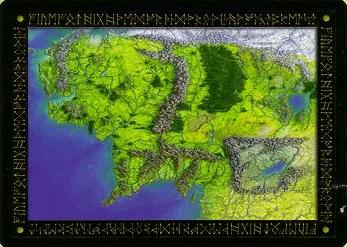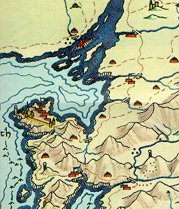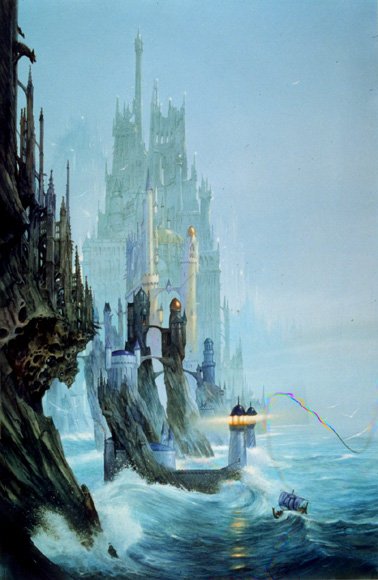

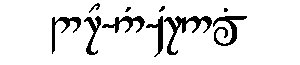
Dor-en-ErnilDor-en-Ernil comprises all the land between the rivers Gilrain and Ringló / Morthond including the hilly penninsula called Belfalas. To the west lies Anfalas, Lebennin to the east. The Realm of Dor-en-Ernil is an autonomous provice in the heart of southern gondor. Two of the most important ports lay within its borders and the capical Dol Amroth is neighbored to the famous elven city of Edhellond. The name "Dor-en-Ernil" is sindarin for "Land of the Prince". The Principality has long prized its autonomy from the central realm.Map of Dor-en-Ernil |
|
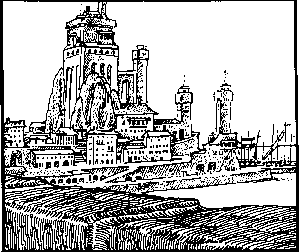
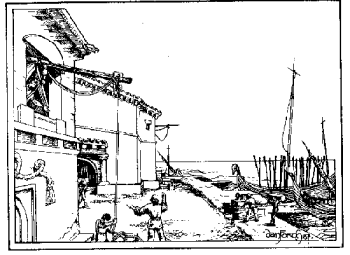
HistoryFirst AgeThe first inhabitants of the land were the Druedain who arrived in the last centuries of the First Age. At the end of the First Age came the Dean Coentis from the east who settled the lands at the Ered Nimrais (S. "White Mountains").Second AgeIn the Second Age came the Sindar who founded Edhellond (S. "Elf-haven"). By 1700 S.A. the Edhellond had become a significant port for the Elves.After the war against Souron in Eriador, the Noldo Galadriel come with her spouse Celeborn to Belfalas. She decided to settle next to Edhellond on a rocky promonotory jutting into the bay call Tirond Aear (S. "Sea-spire"). There she erected a a tower called Tirith Aear (S. "Sea-ward Tower"). After 1800 S.A. the Guild of Venturers arrived around the Bay of Belfalas, bringing Numenorian settlers mostly to todays Lebennin. The Guild was led by Imrazôr in this days - and in the later history was banned by the king. In 3319 S.A. Gondor was founded by Elendil the Tall and his sons Isildur and Anarion, the heirs of the Uinendili. It was the famous Lord Edhelion - a man who was treated by the elves as one of their own kind - who secured and developed the region between the River Gilrain and the Ered Tarthonion. In need to reward this invaluable service High-King Elendil accorded Edhelion the title of Ernil (S. "Prince") and the Land became know as Dor-en-Ernil (S. "Prince´s Land"). Third AgeIn 830 T.A. Tarannon ascended the throne of Gondor and the Princes were granted the western coast of Belfalas as well. Dunedain poured into this fertile land. Galadriel, realising that the age of men has come, resigned Tirith Aear to the reigning Prince, who committed himself and his successors to maintain its warning bell.Aided by the Sindar of Edhellond the Prince raised a mighty Castle on the peak above the Elven-tower. The new capital named Lond Ernil (S. "Princ´s Haven") was build below the fortress.This fine port would later become known as Dol Amroth (I prefer this name and use it all the time :). Gondor´s Kin-strife (1432-48 T.A.) was mostly fought in the Anduin Valley. The House Edhelion stayed neutral in this conflict, but many poeple of Belfalas went to join Castamir army and never came back. Dor-en-Ernil was not only wealthy and the people masters of their craft, the Kin-strife strengthened the political position of Dor-en-Ernil. After the war the rebels fled with most of Gondors fleet to Umbar and started raiding the castal regions of Belfalas. The Prince was forced to strengthen the castles and construct a system of coastal fortifications. With hard labor he succeeded and diverted most of the raiding towards other regions. The Great Plague (1636-37 T.A.) claimed a third of the Gondorian population, although the loss was not as severe in Dor-en-Ernil. After the plague Central Gondor again grew weaker and the autonomy of Dor-en-Ernil grew again. That is the point were most of ICE´s stuff starts. |
|
GeographyBelfalas has a long, rounded and hilly coastline between the mouth of the river Morthond and the Gilrain. The western coast is dominated by steep cliffs and rocky coves. On the eastern side are less dangerous sea-rocks sometimes you find beaches and marches. It is still impossible to land with bigger ships at the Belfalas coast apart from the habours. |
|
ClimateThe average temperature at the coast is warm, the inner parts of Dor-en-Ernil are slightly cooler. Generaly the climate is perfect: you have a mild winter, prolonged spring and autumn and a warm, dry summer.Precipitation is regular - very frequent in spring while the peak storm season is late autumn. The coastline is never clam, but only in spring and autumn it is really windy. Occasionally winds from the sea dance around the Ered Nimrais - suddenly spilling into the narrow river valleys. The inner vales generally are calm in summer, the mountains breezy. In winter the coast is rainly, the inner vales and mountains have moderate snow. |
|
|
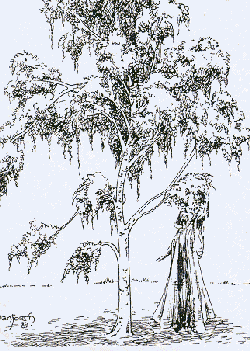
Fauna & FloraHighland lifeThe foothills of Ered Tarthonion are heavily are heavily wooded.The lower vales are filled with deciduous tree including oaks and cedars. Getting higher, the way is given to mighty pines.Marshes and river deltasThe deltas of the rivers Gilrain and Morthond have only a few large trees. Moss-hung cypresses can be found around small lagoons. Waterfowl and other birds could be found. Swarms of insects fill the air. Myriads of fish fill the estuaries. Closer to the bay are clam beds and burrowing crabs.Sea life in the bayVast beds of plankton, marine plants, crustaceans and shellfish have their home at the bay. Even lager ocean creatures are attracted by the large food supply. You can find sharks, whales, dolphins, rays, sea-snakes and sea-turtles as well as fell-turles and kranken. |
|
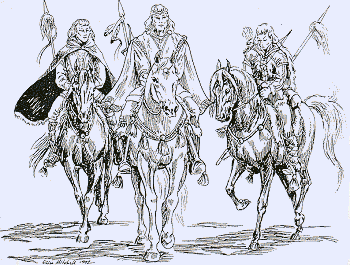
People & CulturesEredrimIn the Ered Tarthonion still a few decendants of the Daen Coentis settle. These people are referred to as Eredrim. Akin to the Dunlendings in the North, they are a bit darker. Generaly the eyes and hair are brown. Men often wear mustaches and thick beards. They rarely get older the 80 years, starting with the physical decline at around 60. They are a secretive folk, the last of a dying culture in these lands.Social Life: A small warrior aristrocraty rules the villages. The main part of a village are farmers and herdsmen. The wealth is shown by the number of cattles a man ownes. Stealing in the own village is regared as a major offence, stealing cattle elsewhere is regarded as admirable act of manhood. Only men go to war, but the woman are known for their courage in defending the homes. There is low unity under the villages, loyality goes to the villages and the clan. They dislike their Dunadan overlords - and flee on the sight of elves. Culture: the Eredrim speak a dialect of Dunael, very rare even some broken Westron. The Shaman is the only literate in these villages, many conversing in Daenael (Old Dunael). The male clothings consists of plain earthen-hued woolen tunics and trousers, wooden clogs or leather boots. Woman wear linen shifts and woolen dresses and also wooden clogs. Only Chieftains and Warriors possess fur mantles and brightly colored clothing. The food is mainly bread and vegetables, only chieftains and warriors can afford regular meat and ale. Houses are of stone, wood or wattle-and-daub. The animals are stabled at one end of the house. Gatherings with food and games are quite common, even between villages. Religion: Eredrim are very superstitious. They generally follow their shamans and believe in the Valar and Natural spirits. Sacrifices are very comman. Cremation is the traditional funeral ceremony. A minority follows dark cults. Under the influence of Saurons agents they follow the "old ways", remembering the power there ancestors had while following the Dark Lord in the old days. DunadanThe Dunadan of Dor-en-Ernil have a good shot elvish blood in there vines. Magic isn´t that bad reputated as in the rest of Gondor, and the ties with Edhellond are quite close. Their appaerance is remarkably tall, black hair, shining grey eyes and fair skin. The man are clean-shaven.Social Life: the land is ruled by a feudal system. There is no dishonour in being a framer or fisher and everyone is a free man, also able to move from one village to another. They pay rent to the local manor lord. The family structur is conservative. Men are warriors, woman play supportive roles as counselors and healers. The Inhabitants are fluently in Sindarin and an archaic, chivalrous-sounding version of Westron. Nearly everone is literate, knowing people often also know Quenya and/or Adûnaic. The traiding people often also know the languages of some neighboring countries. Culture: Men wear long waist-belted tunics, made of linen or light wool. In cooler weather they wear fur or wool mantles and trousers. Sandals and soft boots are common. Ceremonical colthing reflects evlish style. The diet is various and tasteful: sweet bread, meat, fish, cheeses, many fruits and vegetables. Wine, mead and ale are enjoyed. The preferrd building material is stone, and their ability in stoneworking is only surpassed by Dwarves. Nobleman enjoy riding , hawking and hunting for leisure. Commonmen enjoy swimming along the shores and diving from the cliffs. Sailing and the local kind of chess are commonly pleasure. Religion: The Dunadan worship Eru without organized rituals. There is a form of ancestor worship. ElvesAlthough even in Dor-en-Ernil elves are rarely seen, there happen to be a few in the capital Dol Amroth. Where Morthond and Ringlo meet the ocean lies the port of Edhellond - the only elvish settlement in the whole Gondorian region. Not officially a part of Dor-en-Ernil, the Prince and the rulers of Edhellond respect each other and Edhellond keeps the elvish strike in the Belfalas culture alife.Social Life: the leaders of Edhellond are principially Sindar.Silvan (or Avari) make up the ranks of the common folk. Many elves never marry, while those who do have several children. Culture: Sindar wear long tunics and flowing silken robes. They speak Sindarin, but also know Westron as well as the tongues of their Noldor and silvan brethen. Many Sindar are spell users, and are are literate. The Silvan wear functional green and brown tunics and hose, at sea a garb of greenish-blue hue. They speak their own silvan dialects - and a few word in Sindarin. Few know Westron, apart from the ones traveling the land of the Prince. Religion: they revere the Valar. |
|
Politics & Power (1640 T.A.)Status of Dor-en-ErnilAutonomous Principality. Dor-en-Ernil is technically a provice of Gondor, but in fact is much more independant and treated like an state of its own. Unlike the other regions the Prince rules his state with enormous autonomy and his voice is one of the most important in Gondorians affairs- just behind the King and the Steward of the Kingdom. Population Dunedain: 500.000 Eredrim: 15.000 Elves: 2.400 Government
Dor-en-Ernil is a absolute monarchy with feudal structure. The Prince
is an autonomous ruler. He pays annual support to the King, but he rules
as he sees fit. The land is held in fiefs by the lesser Nobility of Belfalas
and Dor-im-Nîn (S. "Land between the Waters") in the North.
These vassals pay annual tax, must enforce the laws in their domains and
join the Princes Army as well as serve in the garrison of the castles three
month a year. All of them join the Princes Army in wartime, many of them
building the heavy cavalry of the realm. Seventeen families hold 90% of
the land. Some local positions are elected. |
|
Politics & Power (1680-1699 T.A.)People and Organisations of Dor-en-ErnilThe people and their position within the structure of the society of Dor-en-Ernil can be found here. The list has the following structure: titel - name (level) - starting date - special location - list of missions, jobs, abilities.Abbriviations: TF - Task Force DG - Delegation 2/72 - month/year Warcraft
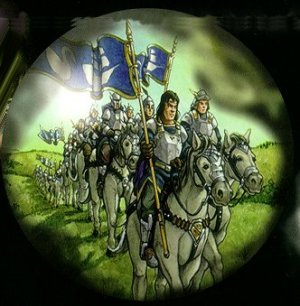
Since Arleod ascended the throne of Dor-en-Ernil in 1667 the warcraft has improved. The Princes
guard Black Rose was set up, led by Terilaan - an former leader of the Elite Guards of Womaw. Like
Arleod he is a Warrior Mage, and till 1688 about a dozen men are able to use some war magic in this force.
Also a mobile force in Harondor of 500 men was set up to guard the southern border of Gondor - and Dor-en-Ernil as
a wealthy country takes more than half the cost of this force. This unit was 1694 brought back home and a mercenary
unit called Nardu Phazan (adun. Princes Men) was formed. The Prines forces gain more fighting experience than any
other soldiers in Gondor. |
|
Dol Amroth
|
|
|
Linhir
|
|
|
Spathlin
|
|
|
Sarlond
|
|
|
Fortir
|
|
|
Endil
|
|
|
Tiriel
|
|
|
Vinhir
|
|
EdhellondEdhellond is a famous elven haven west of Dol Amroth.It was founded by Sindar who arrvied there in the Second Age. The Elf-haven occupies a 150´ high hill that rises out of the lower Morthond less than a mile from the Bay of Belfalas. The rocky hillock forms a 1500´ long isle, which is just over 500´ accross at its widest point. Three stairways connect the gently taraced hillock with the quaye below. The town is surrounded by a low white wall and a ring of silvery oaks. The four high towers with blue tiled roofs sparkle in the clear sky. |
|
|
Prince Arleod and my Dor-en-ErnilWe started playing in 1640 T.A., and now in 1699 T.A. many things have developed slight different from the published things. It took us since 1990 to play these more than 50 years on Middle-earth. Just in case you would like to know what happened since Arleod left Esgaroth in 1640 T.A. and went to explore the world... |